
By Andrew Poncher, SVP & Director of Leasing, Renaud Consulting · Last updated October 20, 2026
The most useful story in DC restaurant leasing this year is not the menus. It is the real estate behind the openings: how much space operators are taking, where, from whom, and on what terms.
At Renaud Consulting we represent restaurant tenants and the landlords they lease from across DC, Maryland and Virginia. Here are five patterns we see in the 2026 openings, and what each one means for your next deal.
The numbers behind the openings
DC retail vacancy sat at about 13.5% early this year, or 17% once you count occupied space that is quietly available. The spread between submarkets is wide, and it explains a lot of what follows.
| Submarket | Retail vacancy | Including shadow space |
|---|---|---|
| Central Business District | 19.7% | 26.8% |
| Union Market / NoMa | 17.1% | 18.2% |
| Navy Yard | 16.1% | 16.8% |
| Shaw | 13.5% | 16.9% |
| 14th Street | 12.0% | 14.0% |
| Georgetown | 8.9% | 11.0% |
| Old Town Alexandria | 7.3% | 10.5% |
| DC overall | 13.5% | 17.0% |
Rents follow the same map. Here is what we see in the restaurant and café lease comps we track, covering more than 70 deals signed from 2023 through 2026.
| Market | Typical restaurant and café rent ($/SF NNN) | TI and concessions |
|---|---|---|
| Union Market / NoMa | $50 to $80 | $85 to $160 TI is common |
| Shaw, 14th Street, City Vista | $58 to $68 | About $75 TI on large full-service deals |
| DC Central Business District | $50 to $60; bays under 1,000 SF up to $80 | Often time instead of money: 10 to 22 months of free or half rent |
| Arlington, Alexandria, Falls Church | $40 to $55; Clarendon up to $60 | Second-generation space often delivered as-is |
| Outer Northern Virginia | $30 to $50 | $85 to $155 TI for national full-service chains; as-is plus a few free months for independents |
The pattern is consistent. Where vacancy is high, landlords pay in TI or free rent to land a restaurant. Where it is tight, operators compete for what is left, including alley and second-floor frontage.
1. Office landlords are recruiting restaurants as a leasing tool
Downtown office owners now treat the ground floor as part of the office pitch. With about a fifth of the CBD’s retail space vacant, they have reason to. At 1800 M Street NW, Columbia Property Trust signed Sorn Thai to 4,095 SF on a 10-year lease, opening February 2027. The deal landed alongside an amenity overhaul and 72,000 SF of new office leases in the building.
A block east, Skanska’s 17xM at 1700 M Street NW brought in Uchi, the Austin sushi concept from James Beard winner Tyson Cole. Skanska’s development team framed it publicly as an amenity for the building’s office tenants. The 185-seat restaurant opened May 12, 2026.
For landlords: a restaurant that helps you sign office tenants is worth more than its rent line. That can justify TI or free rent you would not offer a tenant on a suburban pad.
For operators: CBD landlords are motivated, so negotiate accordingly. But plan for weekday-heavy traffic. Uchi opens at 4 PM and aims its happy hour at the 9-to-5 crowd. And build extra time into your schedule: buildouts inside occupied office towers rarely run to plan.
Note the path Sorn Thai took. It proved itself first in about 3,000 SF at Chesterbrook Shopping Center in McLean, then stepped into the CBD. A strong suburban unit is a credible resume for a downtown landlord.
2. Chefs are testing new concepts inside space they already lease
Chef Seng Luangrath recently launched Khao Nom, a Southeast Asian snack-and-sandwich takeout window inside her restaurant Padaek at 2931 S Glebe Road in Arlington Ridge. It runs weekends only, noon to 3 PM, and she plans to add weekdays if it catches on.
The context matters. Luangrath has tried a standalone fast-casual format before, at Tysons Galleria. Padaek itself sits in a 3,500 SF space that cycled through three prior restaurants before she took it. Khao Nom lets her prove a fast-casual idea with no new rent, buildout or lease risk.
For operators: before you sign a second lease to test a brand, see whether your current kitchen can run it during off-hours. Check your lease first. Use clauses, trade-name restrictions and signage rights often limit a second brand in the same premises.
For landlords: a tenant adding a revenue stream inside its existing space is usually good for rent coverage. A reasonable consent on a second concept is cheaper than backfilling a vacancy.
3. Small rooms and specific concepts are winning off the main corridors
Chef Sebastien Salomon’s Itiyah, billed as DC’s first Haitian fine-dining restaurant, seats 20 at 1416 11th Street NW. Washingtonian describes the block as largely residential, just off Logan Circle. A tasting menu does not need foot traffic. It needs a destination guest and a reservation book.
That changes the math on small spaces. A 20-seat tasting room can work in 1,500 SF where a 100-seat casual concept cannot. It also widens the tenant pool for small ground-floor bays on secondary blocks.
For landlords with small Shaw and Logan Circle bays: don’t limit your marketing to concepts that need corner visibility. Chef-driven, reservation-led operators are a real tenant category here.
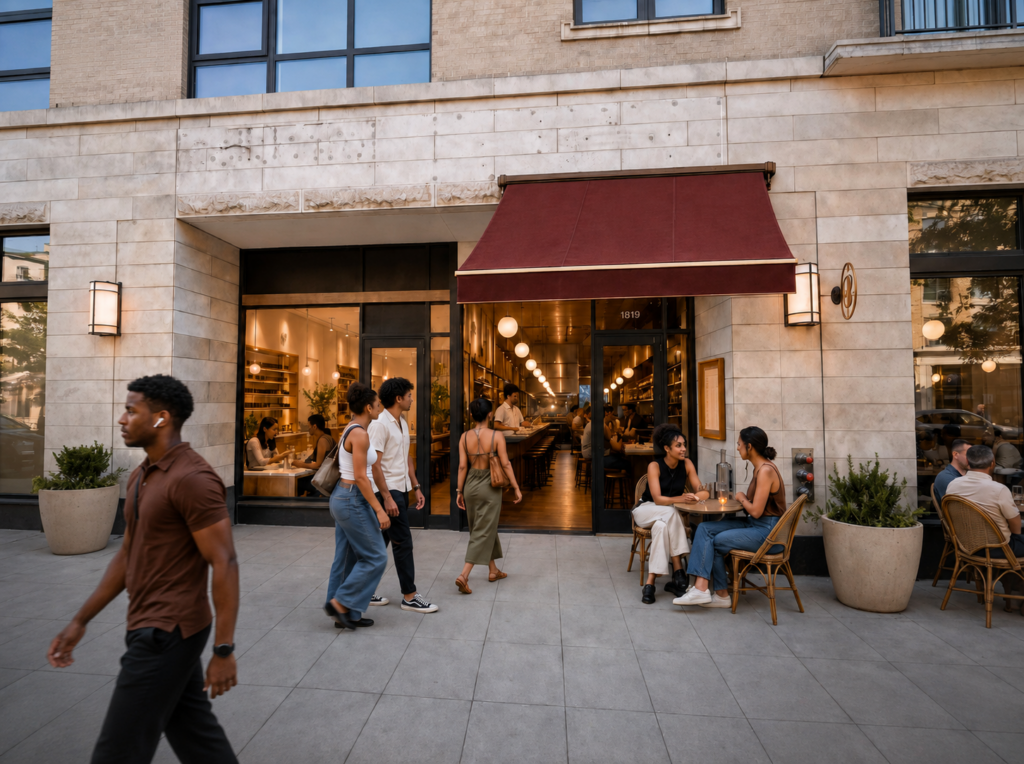
The same math applies on Shaw’s main streets. We are marketing Progression Place, about 1,575 SF of ground-floor retail at 1819 7th Street NW in Shaw. That is the footprint these concepts are proving out, on one of the neighborhood’s busiest corridors. Contact us for details.
4. Second-generation space is changing hands between operators, not landlords
In Bloomingdale, the owners of établi did not just close. They partnered with neighborhood residents Jeremiah and Anthony Brooks to relaunch 84 T Street NW as Bramble & Rye, which opened this fall. The établi wine club carried over to the new restaurant, so the customer base stayed in the building.
In Georgetown, chefs Alex McCoy and Justin Ahn reopened Alfie’s on September 2, ten years after a short-lived 2016 pop-up in Park View. The new home is a 25-seat room at 1228½ 31st Street NW, off an alley shared with Two Nine Omakase and an incoming pizzeria. Alley frontage works when there are enough destinations around it.
For operators selling or exiting: a handoff to a successor can recover more of your investment than walking away. Plan it with the landlord early. Assignment rights, FF&E transfer and any guaranty release need to be settled in the deal, not after.
For landlords: an operator-to-operator handoff can avoid months of dark time. Decide in advance whether you prefer an assignment or a fresh lease, and what credit you need from the incoming tenant.
5. Global brands are entering the US through walkable suburban main streets
South Korean café chain Twosome Place chose 404 King Street in Old Town Alexandria for its first US store. It opened October 17, with customers lined up from the 7 AM open until close. The brand has more than 1,750 locations in Korea, has been owned by DC-based Carlyle since a 2021 deal, and plans more stores across DC, Maryland and Virginia.
It did not pick a mall or a downtown office lobby. It picked a historic, walkable retail street with both tourist and neighborhood traffic, in the tightest submarket in the table above at about 7% vacancy.
For landlords on King Street and similar main streets: expect more inbound from Asian café, bakery and dessert brands looking for a US flagship. They bring strong backing but no US operating history. Ask for a parent company guaranty rather than relying on a new US entity.
For operators and franchisees: a brand’s first US unit is a showcase. That gives it room to pay for location, and it gives you a comparable when you negotiate nearby.
What this means for your next deal
If you operate restaurants:
- Use a proven suburban unit as your resume when pitching CBD landlords, who are motivated right now.
- Test new concepts in space you already control before signing a second lease, and check your use clause first.
- Don’t rule out small or off-corridor space if your concept draws guests by reservation.
- If you are exiting, plan the handoff with your landlord before you announce.
If you own retail space:
- In office buildings, price the restaurant as part of your office leasing story, not just its rent.
- Market small bays to chef-driven and reservation-led concepts, not only high-visibility users.
- Set your position on assignments and second concepts before a tenant asks.
- Expect international brands on walkable main streets, and structure their credit carefully.
Renaud Consulting represents restaurant tenants and retail landlords across DC, Maryland and Virginia. If you are planning a new location, weighing a renewal, or filling a restaurant space, our team would be glad to talk it through. Browse the restaurant spaces we’re marketing, or send us your requirement or your vacancy and we’ll tell you what similar deals have traded at.
Looking for restaurant space in DC or Northern Virginia? Our restaurant tenant representation team can help. Own a center with a restaurant vacancy? See our shopping center leasing services.
About the author
Andrew Poncher, SVP & Director of Leasing at Renaud Consulting. 750,000+ SF leased over 15+ years.
Sources
- 1800 M Street lands 72,000 SF in leases, Citybiz
- Donsak owner to open Sorn Thai in McLean, Commercial Observer
- Hai Hospitality signs lease to open Uchi in DC, FSR Magazine
- Uchi downtown DC opening, PoPville
- A Southeast Asian snack takeout window opens in Arlington, Washingtonian
- Padaek now open at Arlington Ridge Shopping Center, ARLnow
- A Haitian tasting menu restaurant is coming to Shaw, Washingtonian
- DC’s first Haitian fine-dining concept coming to Shaw, PoPville
- Bramble & Rye coming to Bloomingdale, PoPville
- Alfie’s announces Georgetown opening date, PoPville
- Alfie’s making DC homecoming, What Now DC
- South Korean café to open first US location in Alexandria, Northern Virginia Magazine
- A Twosome Place makes US debut in Virginia, The Korea Times
- Carlyle acquires A Twosome Place, Carlyle